Posts

Showing posts with the label Fuji GSW690

Fen Drayton Fog Lith Prints: Part III

Image
The next, and probably last of this series of Lith prints using images from Fen Drayton. Actually, these were taken on the same day though each is at either end of my commute. The first is on the Ouse River near St. Ives while the second is past the reserve out on some farmland.  Again, I mixed a batch of EasyLith developer (The last! Wolfgang is sending more as I type this.) as outlined before and microwaved it for three minutes before proceeding. The challenge here again was the uneven development in the darker reflection to gauge the snatch point.  For this print of three trees on the Ouse I settled on a 16x9 composition which is a movie screen format but also works for making a mild panorama. On 8x10 paper this works most closely to 9x5". scan009 f8.5 16 sec Ev 3.1 water This one had decent separation of the tree branches. The lighter upper and lower edges of the print may want some burning. scan010 f8.5 64 sec 32 sec burn above horizon 16 sec below tree reflection Ev 3.1...

Fen Drayton Fog Lith Prints: Part II

Image
 To follow on from yesterday's work I had a quick session making another print from this series of images taken on the Fen Drayton RSPB.  This image illustrates the challenges of getting the snatch point correct. In many of the past images it was a matter of waiting for the infectious development to proceed up reed stalks or tree branches until the form was well developed and making sure the highlights did not catch up and begin infectious development.  This one has a mass of trees int he midground made indistinct by the fog. I also wanted to make sure the ripples in the reflection would remain identifiable. In this reflection the bonus would be to get the details of the tree branches.  Again, I made a series of three images with different exposure times. I set up a square crop and set the aperture to f8 to give me an Evof 3.1  (ISO 100) in the water on the left corner.  The best images I managed to snatch at a good time. As mentioned, the diffuse image m...

Fen Drayton Fog Lith Prints

Image
With my current lith printing jag I have learned how to get satisfactory results quicker than in the past and this has encouraged me to do it more. I also get results that lack the grainy gritty look I don't favor. So, time to dig into the back-catalog. Three of four storms have blown through the last week or so and this has kept me stuck at home.  I recalled several years ago photographing on a bicycle ride to work on a wonderfully foggy day. It was one of my first times photographing in fog and I believe I had just bought my Fuji 690 GSW camera.  So, with a couple of rolls of HP5+ I went to work but taking my time enough to capture 2 rolls worth along the way. The bike path follows an old railway bed and so travels through the countryside including some old gravel quarries turned into an RSPB reserve near the village of Fen Drayton.  I metered with my Sekonic 308 and overexposed the fog by one to two stops. The fog was extremely heavy (almost too much so) and being wedd...

Conclave for the Alders: More Lith Work

Image
 Another day, another day in the darkroom. The morning dawned bright and clear; a flawed full moon shown in the west while Venus has risen quite high-up in the eastern sky, the gradient of light-yellow fading to cornflower blue in the east pricked by this one unfailing light. Mollie and I are out for our morning walk around the village, this time to some fields. She noses under the gate and is off like a shot sprinting along the hedgerows as fast as her little legs can carry her. She has that unbounded joy today and perhaps because a terrible storm blew through last night, she feels a sense of relief or release in this clear dawn. As we cross the fields, she zigs then zags in front of me from one hedgerow to the next, joy and happiness with each bounding exertion.  This morning after coffee, cereal and some light reading I decided to address some errors from yesterday and re-print some liths. I have some 8x10 sheets left from previous experiments, some of Seagull Exhibition pa...

Conclave for the Elders: A Vision with Lith Printing

Image
After my initial conventional print success , I wanted to see how the image would translate with a lith print. I took the 8x10 image that was exposed at f32 down to f16 for the requisite overexposure. I know if I can hit an Ev (ISO 100) on the easel in some mid tones that is a good start at 32 second exposure for a higher contrast lith print. This came at f16 in this case. I made two exposed prints at this exposure then opened up one more stop to f11 at 32 seconds. I did not burn the top of the images, though I should have.  Normally these images end up taking a darker look but, in this case, they were warmer toned versions of the original prints.  I mixed Moersch EasyLith as follows 20ml Part A 20ml Part B 700ml old Brown 300ml water Heat in microwave for 3 minutes.  When I stuck the first print in the hot developer brought up an image in one minute and I had to snatch it at around 3 minutes. It went black fast! Subsequent images slowed down but none were outside a 5-mi...

The Conclave for the Alders

Image
Sometimes you see an image and you feel it will really work. (Update: I should clarify the trees here are not Alders as I suggest but are Hawthorne. They don't get this big often, but I felt something was wrong with my identification, so I went back to gather more data.) Image for blog post heading Last month I broke out my Fuji GSW 690 and started to take it around with me, when I was just out for a walk or when I had my large format with me.  It is a difficult camera to get my head around especially when in the forest. A wide angle on a wide negative, you need to get close to most subjects. But I have gotten some nice images. I wrote up my impressions of the camera here ... The day was partly cloudy at Holme Fen and not great conditions for photography but not poor either. I was in an area I have been drawn to in the past with these two alder trees. I could never make anything work in any season I was there. The old problem of visual complexity. It is difficult to photograph tree...

Puddle

Image
 This is a photo I took with my Fuji GSW 690 (65mm f5.6 lens on a 6x9 negative). Taken on Ilford HP5+ pushed to ISO 800 for the dark winter conditions. The occasion was a visit to North Yorkshire to help my wife look after my father-in-law last winter. Sadly he passed not long after this and I will miss such a gentle and intelligent man.  I shot this on a cold wet December day. There was not a lot to inspire me but I whimsically decided for a reflection in the puddle. I had to lower the tripod right down near the ground to have the puddle occupy all the viewfinder. Then should I focus on the the reflection or the bottom of the puddle which was covered in dead leaves like a mosaic? I focused on the reflection and had enough depth of field to catch the puddle bottom. Water was dripping from the tree branches overhead and so I set a reasonably fast shutter speed of 1/30 to 1/60th second. I wanted to catch the ripples from a droplet. I then poised with the cable release until I ha...

Panoramic Intimate Landscapes: Part I

Image
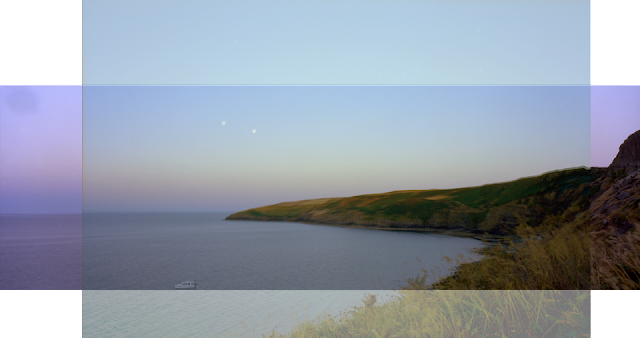
After a lull in my photo taking I have decided to explore the idea of intimate landscape using a panoramic camera. I have a few possibilities in my camera stable. The smallest is the Fuji GSW 690 which gives me a 65mm lens on a 6x9 negative. I also have 6x12 filmback for my Intrepid 4x5 camera which I can coupled with my 90, 150, and 240mmm lenses. Finally the widest is the Fuji G617 which gives a 6x17 negative couple with a 105mm lens.  I made this overlay to show the difference between the G617 and the GSW 690 that while the GSW has a much wider lens 65mm vs 105mm the G617 still wins in terms of wideness.  6x17 (Portra 400) vs 6x9 (Portra 160) formats. (same tripod location) Moon moved due to different times when photo was taken. The challenges with the G617 are many. First it has a center filter to reduce vignetting due to the wide angle. This removes about 1 stop (2x darker as marked on lens). This means ISO 100 film needs to be metered at ISO 50 for instance.  Next...

Chromogenic Film: XP2 Super Experience

Image
A while back I was reminded of chromogenic film such as Ilford's XP2 Super and Kodak's BW400CN No longer available) and Fuji Neopan 400CN. These are based on C41 color film principles except that they only have dyes for black rather than Cyan, Magenta and Yellow. They also lack the orange mask layer found in color c41 films. (Kodak retained the orange mask in their version intended to make black and white prints on color paper.) The rest are meant to be printed on black and white paper generally and so can offer C41 benefits with the ability to print on black and white paper.  Printing C41 color negatives on black and white paper can be done however the colors and mask limits the effectiveness of variable contrast filters. Because the film has color in it you get different amounts of contrast filtration inherent in the image negative colors. This ultimately influences the amount of contrast control achievable. Another limitation is that most black an...

Creativity Motivation and Serendipity

Image
  I have created a video version of my three part blog post about a recent image I printed in the dark room. 

Mathematical Trees 3: My third interpretation from the same negative

Image
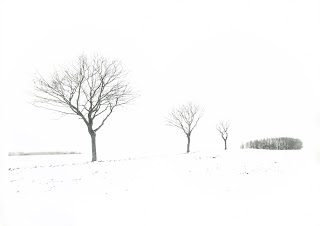
I am now on my third iteration as an exercise of looking at a single negative and finding new ways to express the image. This one like the previous is based on some serendipity during the first image making effort. I found the underexposed images had a different quality. My first take is to make a smaller image placed in the center of a large white area. Since the image is essentially surrounded by white then the whole scene might look like it is imbedded in a snowstorm with a greater feeling of isolation.  Mistaken print I used as a departure from something new. (f32 #5 8 seconds 15x9" on 12x16 Ilford MGFB Classic) For the exposure I want to keep with the hard filter (#5) as I don't want a hint of gray tones in the sky or snow. Bringing the exposure down renders the silhouettes in a grayscale which is what gives the feeling of snow or fog.  My earlier mistaken print indicates #5 at 8 seconds at f32 is about right. However, I want to reduce the image size and place it in a...

Mathematical Trees Part 2: Another interpretation from the same negative

Image
In my previous two posts I set about printing a negative I took recently. I call it Mathematical Trees as there is a kind of geometric balance to the image. It has become for me an exciting image. I think in part because it seems to be a milepost in my evolution as a photographer (and also perhaps because I have not felt creatively motivated this past month).  It is a milestone of sorts because I was not out looking for a specific image but it was immediately apparent when I saw the scene that it was a worth capturing. This does not often happen to me but it does happen with increasing frequency. I could capture the photo and composition and then realize it as a print in the darkroom. In the last post a few printing mistakes led me to consider alternative interpretations and so I will explore one of those visions here. The earlier version was a stark almost graphic take on the image. In this one I want to impart some atmosphere by darkening the sky. ...