Posts

Showing posts with the label Digital to Film

Film from Digital Prints: Fomatone Warmtone Paper

Image
Another print in this series of digital images made into negatives for conventional silver gelatin prints. You can find earlier incarnations here ...  Blog Post Image This time I decided to experiment with a warmtone paper. The genesis of this was that I noted, and Andrew Sanderson master printer prints exclusively on Ilford Warmtone paper. I have a bias towards neutral tone papers and developer, and I typically use Ilford MGFB Classic with a very white baryta paper base or Ilford Art 300 paper with a cotton rage paper that is slightly warm in tone. I use Moersch ECO 4812 developer which is a neutral developer on these papers.  I do not know the reasons for Andrew Sandersons choice but there are some printers that prefer a slightly warm tone and will add a barely noticeable sepia tone to a finished print. It is also possible that it provides more opportunity for toning generally. So I thought why not?  I do not have a warmtone developer however so there is a limit at this...

More 'Ma': Film from Digital Print: Part II

Image
Another print from this series that emphasizes negative space using film negatives created from a digital image.  I made a series of images on the same foggy morning on Lake Pend Oreille in Idaho. There was some ice on the lake and a shifting fog obscuring and revealing the far shore.  I find foggy images exceedingly difficult to print and there can be many interpretations of an image as a result. ( Here is an example of one such exploration of the range of a print's possibilities.) The difficulty stems from the lack of ability to manipulate the contrast using multi-grade paper. There is a limited contrast range achievable even from the highest contrast filter. The negative itself has a very compressed range of tone due to the subject matter. (This is perhaps where digital can excel however the limited range is inherent in the image and even digital can create visible quantization effects unless one is careful in post processing. ) There are other techniques to improve the con...

Sand Creek Lith Prints: Lith Prints from Digital Images

Image
This is a series of prints made from my 'Lower Sand Creek in Winter ' project that I worked on last winter. The images were taken on my Fuji GFX 50s ii digital camera using a Fuji Acros film simulation. I also restricted the cropping to Xpan (65:24) aspect ratio and I used a Tokina 70-210mm f4 zoom lens on an Olympus mount for their 35mm cameras. I further twisted the methodology by making film negatives from these digital images. (A series of blog posts here ...) I made some conventional prints in the darkroom. Now I am making some lith prints from these negatives. Some of the images work better than others as is typical with lith printing.  For this project I broke out an old batch of obscure paper from Agfa called Rapidoprint. This paper was used in newsrooms to make fast prints on a special machine. It is a single weight paper and may have incorporated developer. I first used this paper in 2015 and though very fogged it did lith reasonably well. I am using Moersch EasyLith ...

More 'Ma': Film from Digital Print

Image
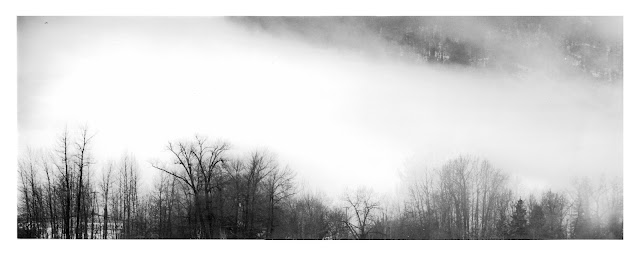
On my pursuit of negative space images, I find these are hard to plan for and one must try and be alive to the idea when they happen. This one I captured on my regular winter walks through town. I was shooting in a black and white mindset with my Fuji GFX 50s ii digital camera set to a 65:19 aspect ratio. This is my favorite setup to use. Presetting the camera in this way mimics some of my film exploits and lets the mind settle on a certain style by removing choices. Fixing the aspect ratio forces a compositional dynamic that opens up possibilities for me as much as it forces a constraint. In this case the low cloud and fog between the screen of winter trees and the mountain created this veil of mystery and lets one's mind imagine the whole scene. The screen of trees provide some tonal weight to help ground the image.  I had this image converted to a 6x7 medium format negative using the services of Gammatech. This allows me to put it in my 4x5 enlarger. I set the condensers for the...

Progress of a Print: Film from Digital

Image
I received another set of negatives from Gammatech the other day. This time I I had the negatives made on 6x7 medium format film. I was partially following my reasoning from another post on the subject where I concluded that medium format would probably yield good images at a more reasonable cost than 4x5 film. Unfortunately, I opted for 6x7 as it maximized the fit of some Xpan (65:24) aspect ratio images but I continued this onto single 4:3 aspect ratio (native Fuji GFX ratio) images and of course I cannot fit these completely in my 6x6 enlarger.  I decided to make a couple of prints cropped square anyway. The print turned out pretty well.  I started with a square 8" x 8" crop from 9 1/2" x 12" Ilford MGFB Classic paper. For some reason that I don't recall I have two unopened 50 sheet boxes of the stuff. This gives generous 3/4" borders and a large blank border on the bottom which lends a kind of balance to the print. So, I retained this 3 1/4" botto...