Posts

Showing posts with the label ORWO

2023 First Darkroom Work (Part 2): Gradient and Selective Toning

Image
The next phase of any lith printing I do tends to be toning. I never feel in control of my toning, but I manage to stumble into some interesting images as a result. Today I played with some sepia and gold toning but didn't really get anything I liked. I moved onto selenium toning as there can be some rather intense results.  Blog Post Thumbnail Image I use a 1+3 dilution of selenium which always results in strong color changes. For most of my lith the end point (to completion) of selenium toning is a rusty red almost strong sepia tone as seen below.  Wistow ORWO f11 23 sec burn sky 45 sec toned On the way to this color, it passes through a cooler almost purple tone. This led me to think about getting a combination of tones though selective toning. I have done this before, and it works well for images with a strong line like a horizon. I dip the wet print only up to the point I want toned. I try and be careful about where the toner goes. The toner effect can lag quite a bit in ...

2023 First Darkroom Work (Part 1)

Image
After much upheaval in my personal life living a semi-nomadic existence in the USA and UK I have not been in the darkroom for some time. My last effort was at the very end of May just before my move to the USA. I am back in the UK for Christmas and New Years and found some time to do some lith printing. I had to look through the back catalog to find some subjects to print.  Lith Printing Recap In many ways lith printing is easier than conventional printing. The exposure is not critical, and I learned some important techniques back in 2021 that made lith finally click for me. For instance, I meter the exposure on the easel at Ev 4 (ISO 100) in the highlight areas of the image using an incident light meter. This corresponds to about 45 seconds of exposure. I usually bracket this +/-1 stop to start with. Burning helps a lot to balance the exposure on the print. Any sky wants a stop or 2 of burn to bring the tones in line with the foreground.  I also crop out areas that are too ...

Aversley Wood Lith: To the Unknown

Image
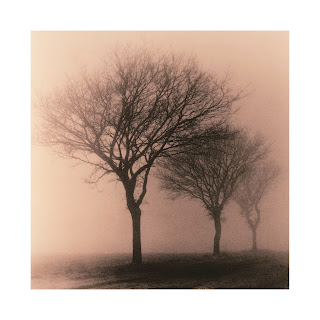
Another set of Lith prints. My last session from this set of negatives I explored as far as I could. The toning did not turn up anything interesting. This next image I have passed up for conventional printing I think because it is off balance. There is a lot of white space on the left side. It does, however, have layers in the branches in the fog and I came to think that what is there is what is not there. That the point of the white space is to suggest what is not there, the unknown.  So, I started to print and develop it with lith developer.  I measured the Ev at ISO 100 in the brushy area under the trees on the right. I set the aperture (f8) for 32 seconds at Ev of 3 which is my reference point. (Again I opened the aperture one stop to f5.6 to cut the exposure time to 16 seconds.) The bright empty area is a full stops less light on the paper so I knew some burning there would be needed.  I tried 2 stops of burn on the left at first, but this was too much so I settled...

Printing Mathematical Trees Study: Lith Developer

Image
This is the second in the series exploring the images from a study I did on some trees in the Cambridgeshire countryside. This post contains a lot of detail notes of the process a more readable summary of the  project is here . Blog Post Cover Image This time I am looking to lith developer to see if I can improve contrast. I have a love/hate relationship with lith as I have found it very difficult to get consistent results. This is often what makes it attractive to others however. I also don't like the long development times and in the past resorted to  heating the developer .  Never-the-less I embarked on this branch of the journey of these prints with such low contrast.  I found the results so good at one point that I kept venturing deeper into lith territory. I found the rewards of  persistence and research.  Lith Prints I mixed up a batch of Fotospeed Lith developer 15ml+485ml water for each part A and part B per instructions.  I started out with t...