Posts

Showing posts with the label contact print

Contacts Prints Part II

Image
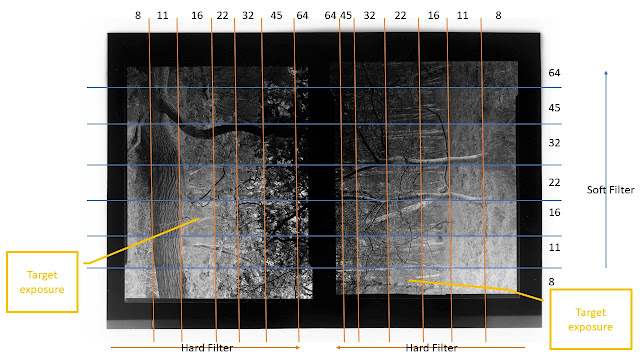
Last month I made 4x5  contact prints which, until then, I hadn't done in quite a while. I liked the format I made up for 8x10 paper by placing two negatives on one piece of paper and leaving the film rebates in place. Retaining film rebates on images seems to be a recent trend amongst new adopters of film. I suppose it gives the image a badge of authenticity or a nod to the retro nature of the work. So I suppose I have adopted this custom in these images. In any case I like the look so perhaps I am finally trendy! (An alternative format I am considering is to use a piece of 8x12 paper, cut from 16x12 paper, with the prints arranged side by side in landscape orientation.) I used the same test print methodology as in the previous post. This got me to the first print that was pretty close. For the upper low oak image, I used only 16 seconds of the #5 filter as it is very low contrast. For the lower birch image, I used 8 seconds #00 and 16 seconds #5 filter. First Print I decided bot...
Large Format Contact Prints

Image
A couple of my recent black and white prints from Holme Fen I decided to contact print. I don't contact print often so my methodology is not refined or honed by practice. I use my enlarger and printing easel and just add a sheet of plain window glass to sandwich the negative to the paper. Since I had two negatives I wanted to print them at once to save some time. I arranged the negatives on a sheet of Ilford MGIV Classic FB paper. A further complication is that I do split grade printing generally and making two test prints simultaneously present a slightly greater challenge as I had to expose for soft and hard filters. I considered just digging out my grade 2 filter but resolved a method to get split grade printing to work.   First I would make the test print with the soft (#00) filter from one direction across both negatives. Then I would make the hard filter (#5) test prints orthogonal to the soft filter intervals by using two black cards to block each strip of exposure incr...

The Making of the C.C Morse Photable Book

Image
Introduction (Originally written in Oct 2016) A Photable My grandfather Cushman Morse (the Grandchildren knew him as Grandpa Cushy) tried to start a small business shortly after he he moved his family from Mattapoisett, Massachusetts to Phoenix Arizona around 1948. The move precipitated by my father's asthma where a drier climate was recommended. My grandparent lived the rest of their lives in Arizona. My grandfather was an avid photographer at the time and would later start camera store in Phoenix called Cushy's Cameras. He used a large format 4x5 view camera though I am unsure of the make. The business was called Photables and were coffee tables with a large black and white print under glass. In a previous post on this blog I said... He had a local carpenter make the tables and he took the photos, usually custom, that he then placed under a sheet of glass for the table top. He started with a 4x5 negative and printed it in his own darkroom. My father recalls he devel...

Archival Print Labels Project

Image
This articles outlines the process I use to make archival labels for my prints using mostly photographic processes. The work involves taking digitally printed artwork, making a lith film negative and finally a label on photographic paper.  Motivation Over the years I have begun to label my prints. This is somewhere between vanity and pride I suppose and of course one is expected to sign one's work. I have worked on imprint or 'brand' based on the inspiration I get from my deceased brother. Thus I have this idea of a studio we have together. This never happened in real life. He pursued his interest and career in photography while I pursued separate interests though we always discussed his interest and I have a couple of his photographs he gave me as gifts. So the idea of a joint photography studio is a virtual concept in that our work was never contemporaneous. Since his death I inherited most of his negatives and over the years I have enjoyed printing and framing t...

Salt Print Transparencies on Expired Film

Image
Always interested in trying something new I decided to try salt printing the predecessor to black and white film photography. I did the usual perusal on the web A Dash of Salt - Alternative Photography   St Paul's Photography-You Tube How to make salt prints – the video - Alternative Photography  And many other articles a Google away. Basically salt (kosher or sea salt as we shall see later) and silver nitrate. Citric acid is helpful. While reading about traditional paper-based prints one sees an emphasis on using sized paper. Now sized paper typically means a gelatin (or other material like arrowroot) coating. The sizing allows the silver image to sit on the top of the paper fibers rather than in them. This is seen as producing a sharper image. Some however prefer the un-sized paper as they like the depth of the image. In reading this it occurred to me that photographic film is really just sized plastic film. I have a few boxes of expired 4x5 film. I thought...