Posts

Showing posts with the label 8x10

Physical Split Printing and Toning

Image
Introduction I have long been a fan of split filter printing where you expose the paper with a low contrast (soft) filter and then a high contrast (hard) filter. The balance of exposure times give the degree of contrast one wants. I find it a more intuitive and easier system than hunting for the right filter value. It also allows more dodging and burning control.  Recently I have been exploring toning and there is a split idea here too. Toning with two different toners to change the warmth and character of the image.  Thirdly a few months ago I stumbled upon a technique I called Lith-Lith where I developed a Ortho Litho film with lith developer aiming to get a higher contrast image. This failed, however I did get a sepia colored transparency that I mounted in front of some aluminum foil to produce a spectacular result.  This led me to think about how to combine these techniques. I had run out of my original Orth Litho film from Photowarehouse in the US and with no prosp...
A FIlm Holder for Cibachrome Drum Developing

Image
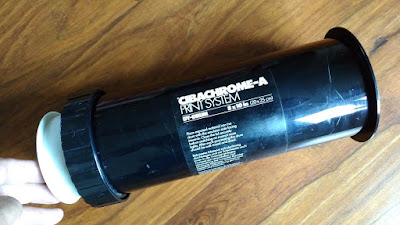
Introduction In other posts I have documented my use of Cibachrome drums which are designed to develop 8x10 sheets of Cibachrome color print paper. Cibachrome has not been made since 2009 so these come up often. I also found the motor unit that rotates the drum. Cibachrome Drum  Drum with Motor Unit I originally bought this to develop Cibachrome from expired paper and chemicals ( See link here. ).  Eventually I made us of it to develop 8x10 film as a cheap developing tank. For 8x10 you roll the film up emulsion facing inside so that it lines the inside of the drum. This is done of course in complete darkness. The lid is then screwed on and after that the rest of the operations can happen in normal room light. The lid has a small reservoir that holds about 250 ml of chemistry. You fill the reservoir with the developer while the drum is upright. The the drum is laid on its side and rotated. (I would roll it along the kitchen countertop until I got the motor unit.) ...

Big Eye Gets 4x10

Image
I had thought up an idea of modifying a dark slide to allow me to make two 4x10 panoramas on a single sheet of 8x10 film. I found this is not a new idea. It is referred to as an L-shaped dark slide. I cut it using a utility knife. It is shown below. L-shaped Darkslide First the scene is composed on the ground glass to fit either the upper or lower half of the ground glass. The L-shaped darkslide is inserted after you remove the normal dark slide before the shutter is opened. Slide the L-shaped dark slide in to cover the opposite half that was composed on the ground glass. Snap the photo then remove the L-shaped dark slide  and insert the normal full sized darkslide. The tricky part is remembering which half has been exposed. I took it out today to try it and got a couple of photos. The best one here. Contact printed on a half sheet of 8x10 Ilford MGIV Deluxe RC paper. 4x10 Print (note geese in lower left corner) Here is an 8x10 of essentially the same scene for refere...

The Big Eye Camera:Testing with Negatives

Image
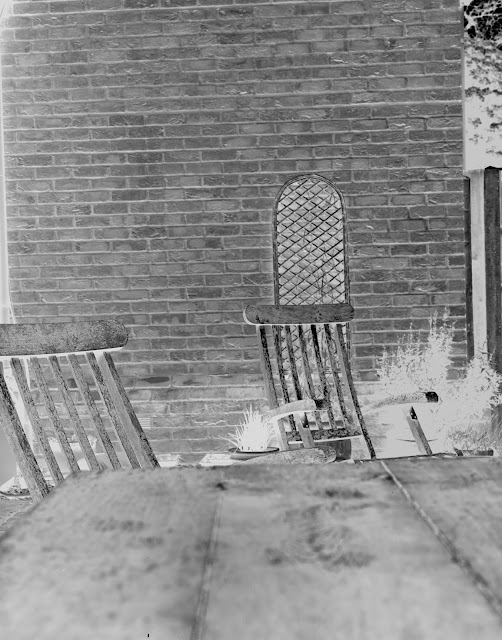
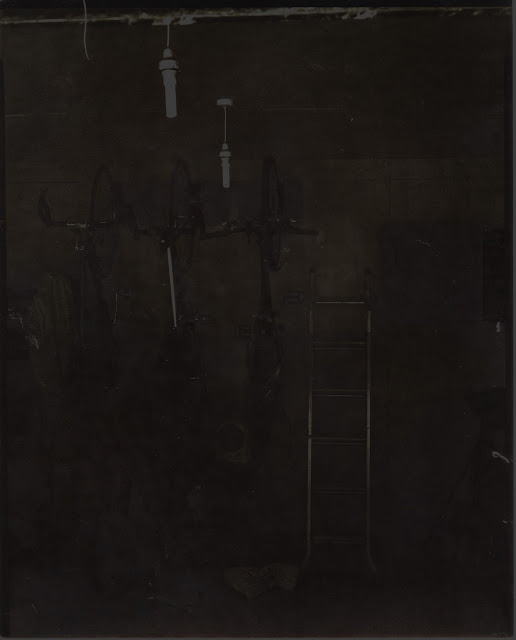
Previous posts showed how I built and tested my 8x10 camera. Ugly but it so far works quite well. I have more work planned for it (blackening the interior, adding a landscape mounting, shutter etc) For now I wanted to try real film. As mentioned before 8x10 film is expensive which is why people often use paper negatives or ortho lith film for economy. Silverprint had some Fomapan 100 8x10 on sale so I got a pack of 50 sheets. Fomapan is popular because it is so economical. It has trouble with being contrasty and it has very high reciprocity failure so is difficult for long exposures. Many people like it in fact and I have learned recently how to tame contrast in film. I took two photos in my back garden. The first I focused on the chair back and the second the brick wall. I wanted to see about depth of field. I metered the scene at ASA 80 to help with the contrast I would give a slight over exposure and then under-develop the film. Both shots were the same exposure 1/2 sec at f45. ...

Galaxy Direct Positive

Image
I had joined the original Galaxy Kickstarter campaign for direct positive paper and bought a pack of 8x10 paper. I generally support new film activities (for instance I also support the Ferrania Film Project as well.) It turns out Galaxy convinced Slavich to repackage their photo-booth paper into larger formats and perhaps reformulated the reversal chemistry. As annoying as the website is I think it is all to the good that they are generating interest and support in traditional photography. The biggest complaint I have is there is very little technical information about the product and as such one is reliant on their chemistry which is fine but never seems to be in stock at least in the UK. (This seems due to some restrictions on shipping some of the chemicals in Europe.) Having a 8x10 large format camera now I want to use the paper so I suppose I need to create my own reversal chemistry. Reversal is a clever process used in slide film and black and white and colour movie st...