Posts

Showing posts with the label Aversley Wood

Aversley Wood Lith: To the Unknown

Image
Another set of Lith prints. My last session from this set of negatives I explored as far as I could. The toning did not turn up anything interesting. This next image I have passed up for conventional printing I think because it is off balance. There is a lot of white space on the left side. It does, however, have layers in the branches in the fog and I came to think that what is there is what is not there. That the point of the white space is to suggest what is not there, the unknown.  So, I started to print and develop it with lith developer.  I measured the Ev at ISO 100 in the brushy area under the trees on the right. I set the aperture (f8) for 32 seconds at Ev of 3 which is my reference point. (Again I opened the aperture one stop to f5.6 to cut the exposure time to 16 seconds.) The bright empty area is a full stops less light on the paper so I knew some burning there would be needed.  I tried 2 stops of burn on the left at first, but this was too much so I settled...

Aversley Wood Lith: Creative Enhancements

Image
I went looking for another image in the back catalog to try some of my recent lith work on. The one I settled on was one taken on a foggy day (Fog seems to fit these techniques well where contrast manipulation is difficult with multi-grade papers.)  This one I never successfully printed. Taken across a field from the edge of the woods, the fog was so thick as to almost render the trees invisible from that distance. When I was there the edge of existence seemed compelling. In a print it amounts to a lot of white paper except for the foreground.  Scan of negative The scan above has the contrast tweaked quite a bit in curves. After composing and focusing (a grain focuser comes in real handy here) I started by setting the aperture according to my Ev (@ISO 100) of 3 rule as measured in the fog. This left the trees around Ev 4 and the field in the foreground around Ev 5. This gave me f8 for 32 seconds though most I printed at f5.6 at 16 seconds which is the same exposure but just a ...

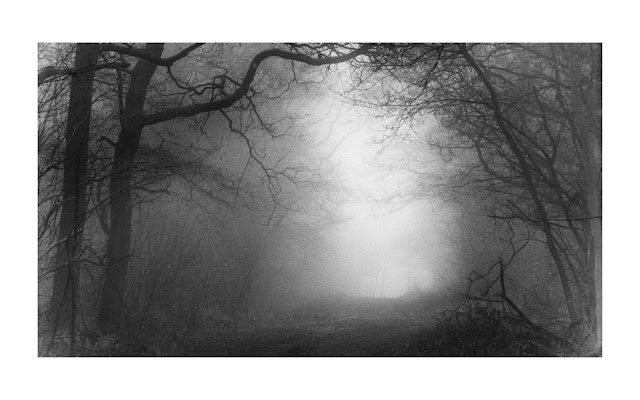
Print Journey Part V-Foggy Path in Aversley Wood

Image
Finally I will explore this image in Lith developer. Lith can be very slow and frustrating but my earlier experience with low contrast images showed some real potential to create a new image. I mostly have 8x10 lith paper (Oriental Seagull) so I will have to opt for smaller images but I will stay with a 16:9 aspect ratio as it suites this image so well. This time I will go for 9x5 on 8x10 paper which is nearly the same ratio (1.8 vs 1.78 for 16:9).  I reviewed my prior posts on lith developing here and here . I then made some notes based on results for Oriental Seagull.  60W lamp 0xND filters No filtration 9x5 image on 8x10 paper Reference point f4 at Ev 2.6 in fog from earlier print Reference point f5.6 @ 45" with 1/2 stop burn where needed 30g Part A Fotospeed Lith 33g Part B Fotospeed Lith I then setup the the enlarger, easel and focus. I found I got Ev 2.5 in a foggy area at f5.6 to match as close as I could what I had done before. I mixed the developer by throwing out hal...

Print Journey Part IV-Foggy Path in Aversley Wood

Image
 As promised in my previous post I decided to pursue a low contrast filter approach to this print. My rationale was that the steep transfer curve of the #5 high contrast filter left me on a knife edge in order to manipulate tonality. Having spent some time in the darkroom this evening I can confirm my hunch was half right. The #00 filter on this image does yield a much greater range of tonality. I ran a test strip at f4 and at f8 (2 stops less light). Each test strip is 3 stops in range so there is one stop overlap. I ended up with over 4 stops of exposure range where some part of the image was visible. With the #5 filter it was probably on the order not more than 3 stops.  What is also clear however that when I reach comparable dark tones of the images I produced with the hard filter there is missing contrast. The hard filter was contributing something toward the final image I produced. I could not expect to reproduce that with dodging and burning either as it si local contra...

Print Journey Part III-Foggy Path in Aversley Wood

Image
After Part II I moved on to taking the 16:9 image to a fiber-based paper print. I have never really come to terms with RC paper though it is enormously cheaper and easier to wash and flatten.  (Ilford has their new portfolio RC paper on a heaver paper base and better emulsion however it is as expensive as fiber-based paper. The various talk about the non-archival nature doesn't really excite me however. I doubt my work will be remembered in 100 years and it is not clear that RC paper wouldn't last that long anyway.) 16:9 Why?  I suppose I should answer why I chose 16:9. Mainly because it was the crop that got me the most from the image while removing distracting elements at the top of the image. Also Flickr's app has this one crop aspect ratio choice. :) I have long had a preference for wider images as well hence my use of 6x17 and 6x12 format images. I have come to enjoy cutting paper down to custom sizes. I often take 12x16 paper to 8x12 or 12x12 for instance.  My wife ...

Print Journey Part II-Foggy Path in Aversley Wood

Image
For the next phase I used my #5 filter test print as a jumping off point. As I said I was intrigued by the darker images represented by the 64 and 45 second exposures.  #5 test strip bottom to top, 16, 22, 32, 45, 64 seconds I started by making straight 64 and 45 second exposure prints in the #5 filter to judge the overall tonality.  #5 64 seconds #5 45 seconds These straight prints I find informative. The challenge with the #5 filter is that the transfer curve of exposure vs density is much steeper than the #00 filter. This means that on a very short range of exposures you can go from white to quite dark. In Part I the original test strip went from white to quite dark on the #5 filter in about 4 intervals (each is 1/2 stop)  or 2 stops while the #00 filter achieves the same range in 6 intervals or 3 stops.  In a low contrast negative this means it can be a challenge to see where the transitions between highlight and shadows are. In a normal or high contrast negative...

Print Journey Part I-Foggy Path in Aversley Wood

Image
A couple of months ago I made it out on one of the last foggy days this winter. I chose Aversley Wood as it is reasonably close and I had been there only a couple of times before. It sits above Sawtry near where the monastery that gave Monk's Wood its name was located. It was a good day out. I got a couple of good images. I was out with my Mamiya 645 and shot mostly 150mm with and without 2x teleconverter and my 80mm lens. I shot Ilford FP4+ at ASA 80 developed in a HC110 dilution B at -20% of massive dev chart development time. I also shot some Fuji Pro 400H color film which is on its way to the lab. The delay was because at 15 images to a roll I didn't get through all the film rolls on that one day. I took the black and white film into the darkroom to print a couple of the better images. What did I learn?  Virtually Every Image Can be Printed in Multiple Ways This has been a recent theme ( see here... ) and has become an ingrained truth for me. This is especially true of blac...