Posts

Showing posts with the label Sepia Toning

Film from Digital Prints: Comparing Ilford MGFB Classic and Fomatone MG Classic Warmtone

Image
I have been experimenting with Fomatone MG Classic Warmtone paper recently. I have found it has a pleasing look when developed in ECO 4812 which is not a warmtone developer. It maintains a warmer tone that can verge on green in some light. I do not like green toned prints and have remained confused as to why this is considered a warmtone.  However this paper has grown on me. Along the way I have tried some toning, and this can clean up any residual green tone if it becomes too bothersome. The paper tones well in sepia toner if more brown tone is desired.  As part of this process, I decided to investigate the same print on Ilford MGFB Classic which is a neutral to cold tone paper. This is my usual paper which when developed with Eco 4812 developer has a nice neutral tone. This paper does not tone well in sepia . A very small amount of sepia takes the colder 'edge' off the print, but further toning gives a cloying pinkish tone. As an aside Ilford MG ART 300 paper gives a much ni...
Film from Digital Prints: Toning

Image
A few days ago, I completed a set of prints on Fomatone MG Warmtone paper. Mostly to see what this paper was like and to print another film negative made from a digital image. The negative was one I made with my Fuji GFX 50s ii digital camera then had converted to a 4x5 negative by Gammatech in the USA. This I then printed conventionally in my enlarger.  For this project I bought a pack of 10pcs of Fomatone 9.5" x 12" paper. The first sheet was for test strips and then a couple of initial prints before I had what I liked. The remaining sheets I printed at two different exposures. In general, the tail end of such a small packet of paper would not be sufficient to complete another print unless I got lucky. I also wanted to experiment with some toning of the paper so having a number of prints to play with helps me explore the toning topic more.  Toning The basic strategy I decided to pursue was some basic split toning. In general, I find toning is less chaotic than lith printi...

Wye Forest no1 Print: Lith Versions

Image
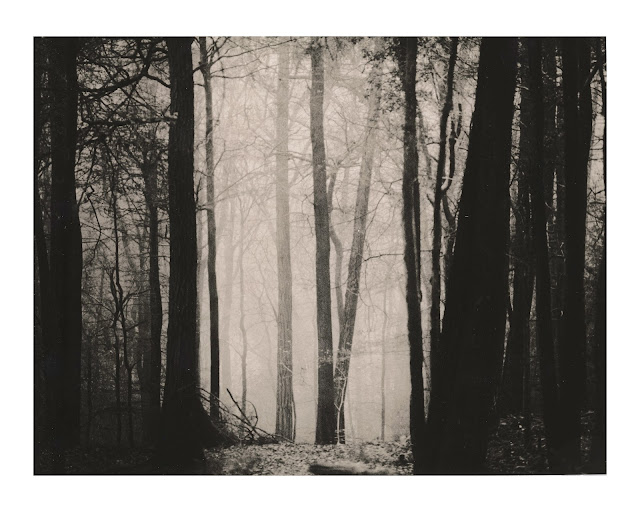
This is another print from the visit to the Wye valley on the English-Welsh border. I first printed this as a conventional print on Ilford RC paper back in 2021. Through the vagaries of Flickr it garnered the most views and second most 'likes' of anything I have posted. (I don't chase likes, views, or explores on Flickr.) I don't know why but it perhaps has to do with not seeming too digital though I also think the dark mood was part of the appeal. This and other similar prints' success have encouraged me to explore the darkness more.  And so, I return to this to see if I can work any lith magic on this image. The original print took some wrestling to get it into the final form. I had to suppress the brightness especially in the upper part of the image in order to achieve the vision of peering into a secret in the deep forest. This turned out to be simpler with lith. I started with a simple straight exposure. I metered the light part of the scene in the center and...

Revisiting Wye Valley Forest: Part IV Making Small Improvements

Image
I decided to try and make some small improvements based on my project print in the previous post in this series. I had a second lith print of the same type as before. The lith development proceeded slightly further on this one making it slightly darker.  Source lith print This one I applied selenium toner on the forest floor though this time with a swab of cotton rather than the riskier soaking. The 1+3 concentration means it does not take much or long for the toner to work.  I then sepia toned the darker left and right sides about 3 minutes before giving an overall sepia tone for about a minute. The resulted in warmer tones on the sides and a neutral tone in the center.  Selenium and sepia toned version This sets the stage for iron toning.  Added Iron Toner Here is the iron toned version. The sepia toned sides still retain their warmth this time. Not too interesting. I am hoping ammonia fogging will spruce it up a bit.  Ammonia fuming This helped moderate the c...

Revisiting Wye Valley Forest: Part III Final Toning

Image
Increasingly I find that lith printing is not an end to itself but a component of creating the final image. These images I have created lately starting with lith printing I think of as being archetypal or perhaps liminal images, if I understand the terms. I plan to discuss these emergent ideas in a later post. I am gaining a better understanding of the process of lith printing and toning and can now direct the activity a little more. I would not think of mastery as it seems to be an unachievable objective and probably would destroy the process if it were achieved. For to master a process steeped in randomness or serendipity would be to thwart the power of the process to create what wasn't imagined before. From my earlier post in this series, I chose a few images to work with. I wanted to use one from the Oriental Seagull paper and one from the Fohar Raster paper. I would tone them differently in different areas.  I wanted to try the sepia toning o...

Revisiting Wye Valley Forest: Inspiration Can Arrive from Anywhere...

Image
The inspiration for this session in the darkroom came to me while I was sitting on the toilet early one morning before I was to take Mollie out on a walk. The house was otherwise asleep and quiet.  As I have shown previously my bathroom (toilet in the UK) is also my gallery for many of my smaller prints. There is one print I call ‘ Ode to Wolfgang ’* that was taken after the first lockdown in the Wye Valley on the border between England and Wales. It was nice to get out on a walk after lockdown on a moody foggy afternoon.  With the hall light on and the door closed to just a slit it cast an interesting light on the print on the wall and made me think there might be an alternative interpretation of the scene.  The Inspiration... I proceeded to make some Lith prints. I thought about making a normally developed print, but I have been enjoying the Lith printing process lately and have gotten some nice results, thus I decided to pursue this vein of creative energy. All of the...