Posts

Showing posts with the label Digital Photography

Rescuing Old Paper: Negra Portrene

Image
When I first began to learn printing in the darkroom, I went through a phase of picking up different expired papers. Partly because they were cheap and also to experience what the properties and history of these old papers were like. Eventually I came to the conclusion that most papers are too fogged to be worth the effort and whatever characteristics they had once have long since diminished with time.  Of course, I use a number of these for lith printing and toning with some great results. Papers like Fohar Raster with an embossed pattern of dots I suppose was to suggest the idea of a CRT? ORWO, Oriental Seagull, Agfa-Gevaert Rapidoprint are some other examples. One paper that stood out for me was Negra Portrene made in Barcelona. At the time I bought some I researched the paper as best I could here ... and determined it went out of business in the 1970's when Spain was still ruled by a fascist dictator.  I bought the paper because it was unopened and 16x20" and I wanted to t...

Lith Printing Nerga Portrene

Image
I have returned to this old paper recently and have decided to try lith printing it again. It is a single grade warmtone paper from the 1970's. When I first bought it I found it lithed well and this has been born out again. I used Fotospeed Lith developer in that first trial and now I use Moersch EasyLith and have learned a bit more about lith printing since then.  Everything I learned in that original post bore out in my work today. The paper develops really fast in hot lith developer within seconds for the first print at a +3 stop overexposure. The developer settled down as the developer cooled and I reduced the exposure. I actually managed to get good prints (indeed the best) with very little exposure. As a gauge of this a reasonable conventional print was made at f8 for 32 seconds. The second print was made with less exposure at f8 for 22 seconds.   I used a negative from my Fuji GFX 50s ii digital camera made at Gammatech . This was an image I took at night during a...

Sand Creek Lith Prints: Lith Prints from Digital Images

Image
This is a series of prints made from my 'Lower Sand Creek in Winter ' project that I worked on last winter. The images were taken on my Fuji GFX 50s ii digital camera using a Fuji Acros film simulation. I also restricted the cropping to Xpan (65:24) aspect ratio and I used a Tokina 70-210mm f4 zoom lens on an Olympus mount for their 35mm cameras. I further twisted the methodology by making film negatives from these digital images. (A series of blog posts here ...) I made some conventional prints in the darkroom. Now I am making some lith prints from these negatives. Some of the images work better than others as is typical with lith printing.  For this project I broke out an old batch of obscure paper from Agfa called Rapidoprint. This paper was used in newsrooms to make fast prints on a special machine. It is a single weight paper and may have incorporated developer. I first used this paper in 2015 and though very fogged it did lith reasonably well. I am using Moersch EasyLith ...

Framing Thunderstorm over Sandpoint

Image
Introduction Last summer I spent a wonderful evening photographing on Lake Pend Oreille looking back at Sandpoint during a thunderstorm that was blowing over the town. I wrote about framing another print from that evening here ... As I was using my Fuji GFX digital camera then I had a large number of images to choose from. Another image I liked was taken with an Olympus 135mm f2.8 prime lens on an adapter for my GFX. This is cropped to a 35mm frame resulting in a 30 Mpixel image. Its funny but this image did not appear on my first choices for images from that evening but a subsequent look helped me understand the understated drama of this image. Blog Cover Image As I look at it now and analyze what I like about it I find the following comments. In terms of composition the light in the upper left of the sun glowing behind the clouds is balanced with some tension by the dark mass of Sunnyside peninsula in the lower right. The hint of the mountain outlines is enough to get the whole story...

Bottle Bay and Gamlin Lake. (Digital)

Image
The other day I was out with my dad for a drive and as usual every trip is a scouting opportunity. The lake here, Lake Pend Oreille, is massive but has very few public access areas. Part of it is geography due to steep mountains but most of it is the sheer amount of lake front private property. So I was pleased to note a section of Bottle Bay road that had a clear view from the roadside across the lake. This made it on my mental list.  Well this morning dawned cool and rainy with soft low lying clouds, fog and mist. This gives the lake a blue mood with a palette to match. I took this as an opportunity to try out my new location and also a few others I saw on the drive. One advantage of winter on the lake is that they lower the water level about 10 feet. State law says that any river or lake shore between high and low water levels is public access. If you can make your way there then in theory the entire lake shore is open. One can walk right under the numerous docks and landings wi...

Fuji GFX Old Glass Configuration (Digital)

Image
In a prior post I discuss the use of ‘old glass’ on the Fuji GFX 50s ii as a means of keeping the cost of the camera system reasonable. Coming from film cameras I find the use of old manual lenses natural to use and not terribly troubling once I got the camera set up properly. In-body image stabilization (IBIS) means I can shoot these lenses at lower shutter speeds without a tripod.  One of my favorite lenses is the Olympus Zuiko 135mm f2.8 lens. It is very sharp and the focal length is ideal for intimate woodland work where a good depth of field helps separate subjects in what us usually a very cluttered environment. One drawback of using a lens made for a 35mm camera is that on the Fuji GFX one tends to get vignetting. So I set up the camera to crop the sensor to 35mm full frame. This works well as even cropped I get 30 Mpix images.  It occurred to me recently that there is a useful’ cheat with 35mm lenses. I have long enjoyed panoramic formats and in my film cameras enjoy ...

In Praise of... Shift Lens Adapter on Fuji GFX 50s ii

Image
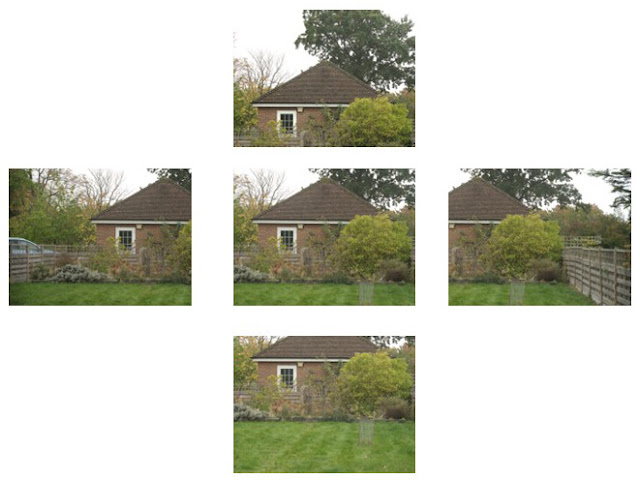
One of the ways I justified to myself the expense of my Fuji GFX 50s ii medium format digital camera was I could get adapters and make use of the large number of medium format and 35mm lenses I already have. I have made a few posts about my experience, one of which is here ...  I ended up getting a Kipon shift adapter for my 645-lens adapter. It is more expensive, bulkier and heavier, but I have a lot of 4x5 experience and often use tilt and rise and thought it would be useful to play with. Tilt is less important I think as depth of field control on the smaller sensor is less of a problem.  Initially, however, I thought the best use would be taking very large, stitched photos by shifting the lens and then rotating it to create a lot of overlapping images. Alas I haven't tried this yet.  For those unfamiliar with shift lenses, I give the following simple example. These photos were taken from the same fixed position on a tripod pointing at the same point. The only changes m...

Framing 'Together'

Image
Introduction One image I took this last summer that I really like I ended up calling ' Together '. It was taken on a calm misty morning after a night of heavy rain. I was up at dawn and had the lake more or less to myself with the exception of one fisherman. The day was still and gray with a soft fog in the distance. I found these two Western Grebes swimming in the lightly rippled calm. I was out with my Fuji GFX 50s ii with a 55-110mm f4 zoom lens. A nice portrait composition came to mind with the grebes in the lower right corner and distant island in the upper left corner. This gave a nice tension as the island helps anchor the scene to give a reference to the incoherent surface of the water. There is faint hint of the water's edge at the horizon and a show of the mountains at the edge of vision. The ripples and subtle shades of blue give lots for the eye to contemplate.  I was walking the road that hugs the shore which places the perspective quite low on the water. I wan...

Lake Pend Oreille Moods: Photobook

Image
I spent the summer in Sandpoint Idaho with my Fuji GFX 50s ii medium format digital camera. My digital philosophy has been to retain and integrate the aspects of film that I enjoy so much. I tend to work with mostly manual lenses and not use a lot of the camera features and menus aside from shutter speed aperture and a new one for me, ISO. I made a series of earlier posts on some of my work which I list below. Old Glass  Lake Vibes Lake Morning June 5 2022 Trestle Creek August First Lake Pend Oreille I have travelled to this area over the years to visit my father and have always found the lake to be a challenge to photograph. It is predominantly blue in tone in the summer owing to many days of bright blue skies. The lake itself sits in a bowl of mountains that makes golden hour somewhat muted. This was an attempt to channel some of the mood of the lake and reflect that in my photographs. I found th...