Posts

Showing posts with the label Ammonia Fuming

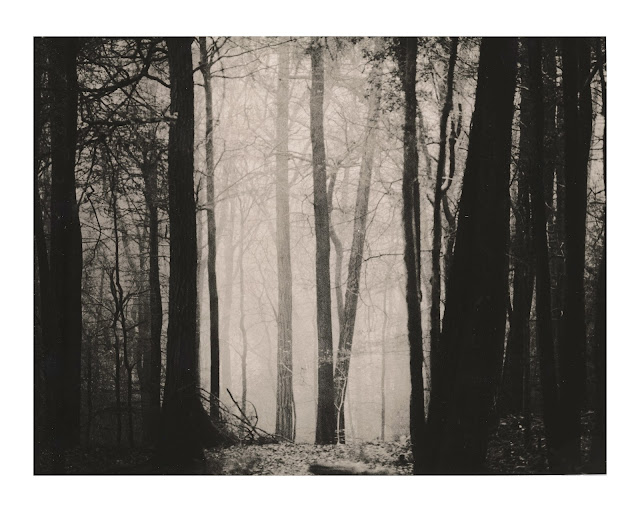
Wye Forest no1 Print: Lith Versions

Image
This is another print from the visit to the Wye valley on the English-Welsh border. I first printed this as a conventional print on Ilford RC paper back in 2021. Through the vagaries of Flickr it garnered the most views and second most 'likes' of anything I have posted. (I don't chase likes, views, or explores on Flickr.) I don't know why but it perhaps has to do with not seeming too digital though I also think the dark mood was part of the appeal. This and other similar prints' success have encouraged me to explore the darkness more.  And so, I return to this to see if I can work any lith magic on this image. The original print took some wrestling to get it into the final form. I had to suppress the brightness especially in the upper part of the image in order to achieve the vision of peering into a secret in the deep forest. This turned out to be simpler with lith. I started with a simple straight exposure. I metered the light part of the scene in the center and...
Revisiting Wye Valley Forest: Part IV Making Small Improvements

Image
I decided to try and make some small improvements based on my project print in the previous post in this series. I had a second lith print of the same type as before. The lith development proceeded slightly further on this one making it slightly darker.  Source lith print This one I applied selenium toner on the forest floor though this time with a swab of cotton rather than the riskier soaking. The 1+3 concentration means it does not take much or long for the toner to work.  I then sepia toned the darker left and right sides about 3 minutes before giving an overall sepia tone for about a minute. The resulted in warmer tones on the sides and a neutral tone in the center.  Selenium and sepia toned version This sets the stage for iron toning.  Added Iron Toner Here is the iron toned version. The sepia toned sides still retain their warmth this time. Not too interesting. I am hoping ammonia fogging will spruce it up a bit.  Ammonia fuming This helped moderate the c...

Revisiting Wye Valley Forest: Part III Final Toning

Image
Increasingly I find that lith printing is not an end to itself but a component of creating the final image. These images I have created lately starting with lith printing I think of as being archetypal or perhaps liminal images, if I understand the terms. I plan to discuss these emergent ideas in a later post. I am gaining a better understanding of the process of lith printing and toning and can now direct the activity a little more. I would not think of mastery as it seems to be an unachievable objective and probably would destroy the process if it were achieved. For to master a process steeped in randomness or serendipity would be to thwart the power of the process to create what wasn't imagined before. From my earlier post in this series, I chose a few images to work with. I wanted to use one from the Oriental Seagull paper and one from the Fohar Raster paper. I would tone them differently in different areas.  I wanted to try the sepia toning o...

Fuming Iron Blue Toner

Image
From my last experiments at using iron blue toning to the moon series I produced some unsatisfying versions of the prints. The blue was overpowering and went across the entire image in an unaesthetic fashion. One advantage of iron toning, however, is that it is reversable with the application of a base such as ammonia. ( Note on Safety : I use household ammonia which is 30% concentration. I also use concentrated acetic acid. Undiluted they are each very powerful and can cause eye and other damage, as well as having strong fumes which are not healthy to breathe in. Not much is used, perhaps 5-10 ml but the area should be well ventilated to avoid getting overwhelmed by the fumes. Please take the necessary precautions.) Example Blue Toned Print I considered restoring the prints to their original selves with an ammonia bath but struck on another idea. I have done fine woodworking over the years and there is an old technique for adding a patina to some wood called ammonia fuming. It wo...