Posts

Black and White Print from a Color Slide

Image
I was scanning some of my brother's 35mm Kodachrome slides from a backpacking trip he did many years ago in the Mazatzals in central Arizona. I was struck by one photo of some Manzanita bushes and thought that would be good to print in Black and White. The slide is below. I would need to transform it from a color positive to a black and white negative. I have done this before with a paper inter-negative but settled on a film inter-negative which I have done before as well. This time however I decided to try a different method of creating an inter-negative. The slide is 35 mm so I figured 6 x 4.5 cm would be a close enough fit for aspect ratio. I didn't want to deal with roll film as I would get committed to an entire roll of film. I can also get four of this size negative from a sheet of 4x5 film. So I started with some Fomapan 100 film which I cut to the 5x4.5 cm size pieces. I mounted the slide in the enlarger and adjusted it to focus as a 6 x 4.5 sized image. Th...

Big Eye Gets 4x10

Image
I had thought up an idea of modifying a dark slide to allow me to make two 4x10 panoramas on a single sheet of 8x10 film. I found this is not a new idea. It is referred to as an L-shaped dark slide. I cut it using a utility knife. It is shown below. L-shaped Darkslide First the scene is composed on the ground glass to fit either the upper or lower half of the ground glass. The L-shaped darkslide is inserted after you remove the normal dark slide before the shutter is opened. Slide the L-shaped dark slide in to cover the opposite half that was composed on the ground glass. Snap the photo then remove the L-shaped dark slide  and insert the normal full sized darkslide. The tricky part is remembering which half has been exposed. I took it out today to try it and got a couple of photos. The best one here. Contact printed on a half sheet of 8x10 Ilford MGIV Deluxe RC paper. 4x10 Print (note geese in lower left corner) Here is an 8x10 of essentially the same scene for refere...

Still Life with Big Guy and Fomapan 100

Image
Some more experiments and photos with the Big Eye (Big Guy) . Again on Fomapan 100. I don't really have the means to lug the camera about yet so having found Jim Galli's website he does some simple still life images which I find inspiring to give it a try. The first is a small bronze horse statue on a table. I lit it with room light which was a mix of artificial and natural light. Basically I turned on the lights and opened the drapes! I metered it at ASA 80 and f8 at 4". For Fomapan the Reciprocity failure is very high. See the table below. Reciprocity Failure for Fomapan 100 For 1-10 seconds I need to multiply the exposure by 2 so that makes it 8 seconds at f8. I developed it again in HC-110 this time I moved from 6 ml to 5 ml as there are different opinions on the amount of HC-110 required to develop a sheet of film. I mixed this at the same ratio as before (1+63) and so added 320 ml of water.  The development time was 8:06 minutes. This is the resulting negati...

The Big Eye Camera:Testing with Negatives

Image
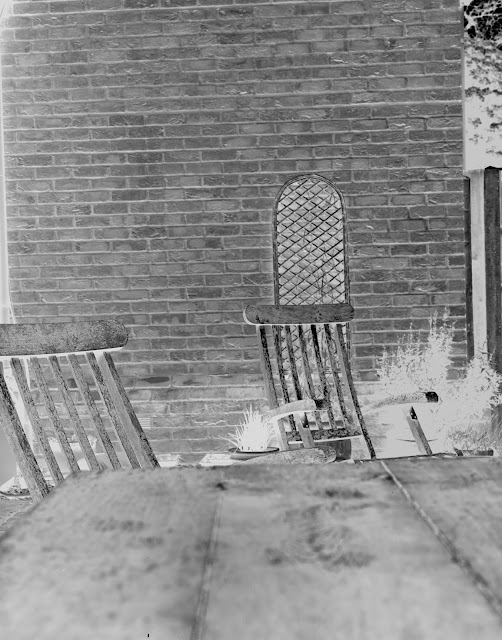
Previous posts showed how I built and tested my 8x10 camera. Ugly but it so far works quite well. I have more work planned for it (blackening the interior, adding a landscape mounting, shutter etc) For now I wanted to try real film. As mentioned before 8x10 film is expensive which is why people often use paper negatives or ortho lith film for economy. Silverprint had some Fomapan 100 8x10 on sale so I got a pack of 50 sheets. Fomapan is popular because it is so economical. It has trouble with being contrasty and it has very high reciprocity failure so is difficult for long exposures. Many people like it in fact and I have learned recently how to tame contrast in film. I took two photos in my back garden. The first I focused on the chair back and the second the brick wall. I wanted to see about depth of field. I metered the scene at ASA 80 to help with the contrast I would give a slight over exposure and then under-develop the film. Both shots were the same exposure 1/2 sec at f45. ...

Paper Negatives Revisited

Image
I first explored paper negatives when I wanted to print a color slide and needed to create an inter-negative in this post . I have since made an 8x10 large format camera and made paper negatives to test it.   Andrew Sanderson at thewebdarkroom has written a nice treatise on the paper negative and I highly recommend buying it. It is available on Blurb . Andrew's book introduced me to new ideas about paper negatives. Surprisingly for me he moves beyond contact prints and suggests loading paper in a medium format or 35mm camera. This can then be put in an enlarger. The result while not as crisp as a film negative has its own quality that he shows suits some subjects. I was inspired to try this out. Some time ago I found a good price on ebay for a rolleiflex/cord back that takes dark slide glass plate holders along with 4 plate holders. At the time the price was negligible and I  thought it might come in useful if I got into making glass plates. It sat in the shelf for som...

Galaxy Direct Positive

Image
I had joined the original Galaxy Kickstarter campaign for direct positive paper and bought a pack of 8x10 paper. I generally support new film activities (for instance I also support the Ferrania Film Project as well.) It turns out Galaxy convinced Slavich to repackage their photo-booth paper into larger formats and perhaps reformulated the reversal chemistry. As annoying as the website is I think it is all to the good that they are generating interest and support in traditional photography. The biggest complaint I have is there is very little technical information about the product and as such one is reliant on their chemistry which is fine but never seems to be in stock at least in the UK. (This seems due to some restrictions on shipping some of the chemicals in Europe.) Having a 8x10 large format camera now I want to use the paper so I suppose I need to create my own reversal chemistry. Reversal is a clever process used in slide film and black and white and colour movie st...

Kodak XX Film for the Minolta 16mm spy Camera

Image
After a failed attempt to use old Russian 16mm film I decided to get new stock and after perusing ebay and reading up on B+W film the obvious choice was Kodak XX (Double X) 7222 16mm movie film. It  is a proper negative film and has a fan base that admires its speed (200 in Tungsten and 250 in daylight) even tones and low grain. 100 ft (a lifetime supply for my purposes, About 1300 photos.) set me back £42. The subclub  has tons of resources for these small cameras. The loading for Minolta cartridges is covered here . I loaded about 8 inches into one of my film cartridges and took some quick test photos with my Minolta 16PS. I shot the photos at ASA 200. I developed the film according to Massive Dev chart in my normal film developer Ilford LC29. The timing for this development was for ASA 250. For properly metered shots the negatives came out well balanced. Scanning 16mm is difficult as I don't have a proper holder and I could not locate the small glass plate I use for t...